AMD to Acquire AI Inference Silicon Startup Taalas
AMD agrees to acquire Toronto startup Taalas to embed hardwired AI models directly onto silicon, tackling energy and latency bottlenecks in inference workloads.
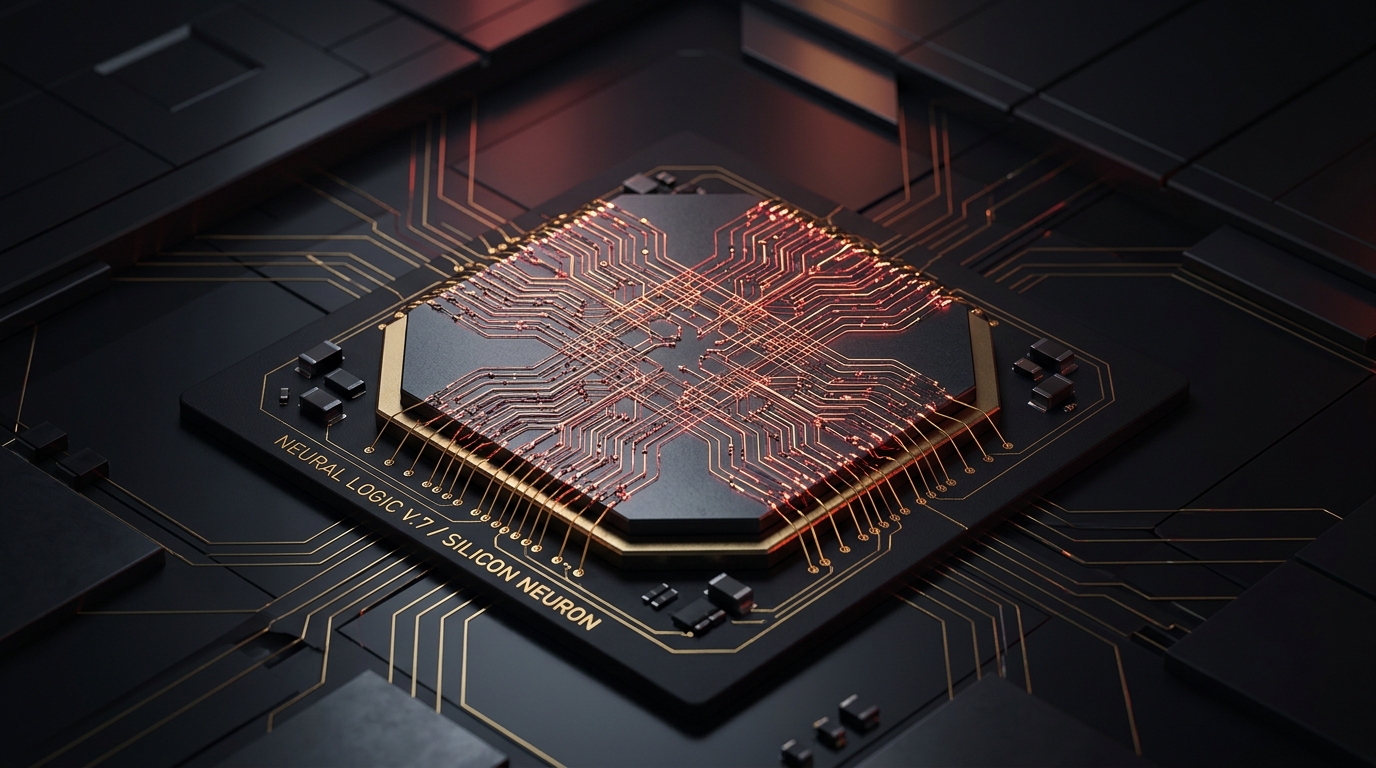
Running large language models at enterprise scale has hit a physical wall. While general-purpose GPUs remain essential for training next-generation models, serving static production workloads on dynamic accelerator clusters wastes huge amounts of power just moving data between chips and off-die memory. On August 6, 2026, AMD moved to tackle that bottleneck by announcing a definitive agreement to acquire Taalas, a Toronto-based startup building custom silicon where trained neural network weights are etched directly into the transistors.
While AMD did not disclose financial terms, the acquisition highlights a strategic pivot in AI hardware. As foundational open-weights models stabilize across enterprise pipelines, hardwiring specific model architectures directly onto silicon offers dramatic performance and efficiency gains over traditional programmable GPUs.
Moving Beyond the Memory Bottleneck
Standard accelerators like NVIDIA's H100 or AMD's Instinct MI300X spend much of their energy budget shuttling model parameters back and forth between high-bandwidth memory (HBM) stacks and compute cores. While this dynamic loading design gives general GPUs total flexibility, it creates severe memory bandwidth limits and heat overhead during high-volume inference.
Taalas, founded in 2023 by former AMD and Tenstorrent chip architects including CEO Ljubisa Bajic, takes a radical path. Under the core philosophy that "the model is the computer," Taalas replaces dynamic memory access by hardcoding a model's weights directly into the silicon logic gates, creating what industry analysts often call Model-Specific Integrated Circuits.
"We founded Taalas to rethink AI inference from the ground up by building the hardware around the model," said Ljubisa Bajic in AMD's announcement.
The company's test vehicle, the HC1 technology demonstrator, highlights the potential of this design. Manufactured on TSMC's 6nm process with an 815mm² die packing 53 billion transistors, an HC1 card running Llama 3.1 8B consumes roughly 200 to 250 watts while achieving up to 17,000 tokens per second per user (though analyst Karl Freund clocked 14,357 tokens per second running a prompt through Taalas' own public demo). By keeping weight parameters etched into the silicon fabric rather than fetching them from external HBM or DRAM, the architecture delivers orders of magnitude higher throughput per watt than conventional accelerators.
Integrating Taalas Across the AMD Portfolio
AMD plans to integrate Taalas' custom silicon technology into its broader accelerator roadmap. "AMD is building a full-stack AI platform that gives customers the flexibility to deploy the right compute solutions for every AI workload," said Vamsi Boppana, Senior Vice President of the Artificial Intelligence Group at AMD.
In its official release, AMD stated that it plans to develop system-level solutions pairing Taalas technology with AMD Instinct GPUs, while positioning the acquisition alongside its broader hardware and software ecosystem:
- Hybrid Node Compute: Developing system-level solutions that pair Taalas inference blocks with AMD Instinct GPUs within server nodes.
- Helios Rack-Scale Integration: Positioning Taalas hardware alongside AMD's Helios rack-scale systems for dense data center deployments.
- ROCm Ecosystem Questions: Listing ROCm software among the platform pieces Taalas will complement, though AMD has not disclosed how a software stack built for programmable GPUs will interface with non-programmable, hardwired silicon.
Notably, AMD has not yet disclosed a concrete technical timeline or detailed roadmap showing when or how Taalas' demonstrator silicon will transition into commercial shipping products.
Strategic Impact on Enterprise Hardware
As open-source weights like Llama 3.1 become standard building blocks for enterprise products, dedicated silicon becomes far more commercially viable. Tech companies no longer need full GPU reconfigurability for every deployed model, making model-specific efficiency a compelling financial advantage.
The acquisition strengthens AMD's long-term AI roadmap with differentiated inference technology and engineering expertise across Canada's semiconductor talent pool. The Register reports the deal is expected to close in the fourth quarter of 2026, subject to customary closing conditions and regulatory approvals.
Sources & References
- AMD Newsroom: AMD Acquires Taalas to Advance Compute Solutions for Rapidly Growing AI Inference Market (Published August 6, 2026)
- AMD Investor Relations: AMD Acquires Taalas to Advance Compute Solutions for Rapidly Growing AI Inference Market (Published August 6, 2026)
- Taalas: HC1 Technology Demonstrator and Products (Accessed August 8, 2026)
- The Register: AMD acquires AI chip startup Taalas to boost inference performance by etching models into silicon (Published August 6, 2026)
- The Next Platform: Taalas Etches AI Models Onto Transistors To Rocket Boost Inference (Published February 19, 2026)
- Forbes: Taalas Launches Hardcore Chip With 'Insane' AI Inference Performance (Karl Freund, Published February 19, 2026)
- Futurum Group: AMD Acquires Taalas to Advance AI Workload Optimization (Brendan Burke, Published August 7, 2026)
- ServeTheHome: AMD to Acquire Taalas for Model-Specific AI Inference Chips (Published August 6, 2026)
More from the desk
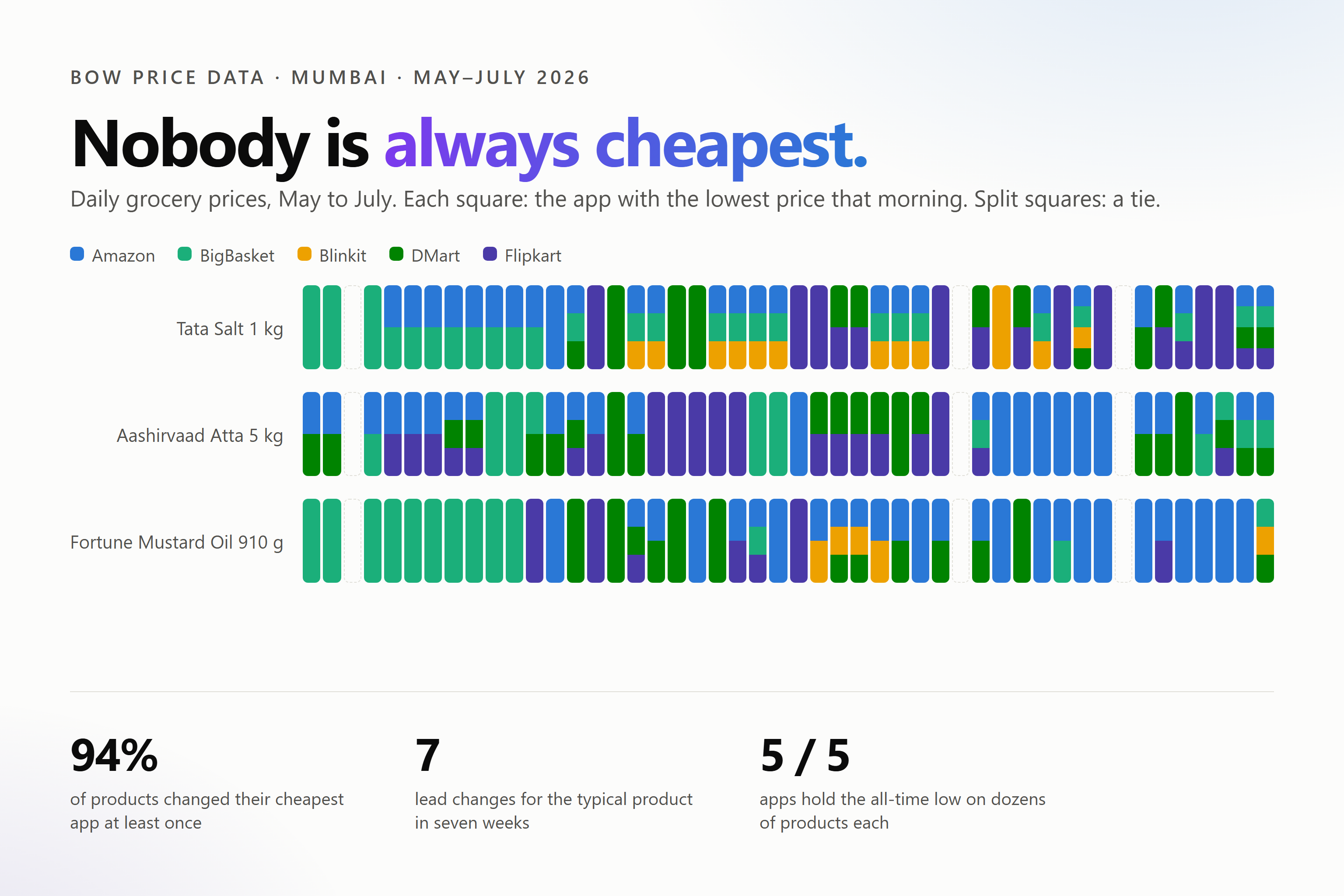
Nobody Is Always Cheapest: What 33,000 Grocery Prices Taught Us About India's Grocery App Price War
Seven weeks of daily price data from BOW, across DMart, BigBasket, Blinkit, Amazon and Flipkart in Mumbai. The verdict: 94% of products changed their cheapest app at least once, every platform holds all-time lows, and the real money is in timing, not loyalty.
Siri AI, iOS 27, and the End of an Era: Everything Announced at Apple's WWDC 2026
Apple's WWDC 2026 delivered an AI-centric keynote featuring a Siri overhaul collaborating with Google Gemini, the release of iOS 27 and macOS 27 Golden Gate, and a historic leadership transition as Tim Cook prepares to step down.
The Agentic Shift: Unveiling Gemini Spark and the Future of Android XR at Google I/O 2026
Google I/O 2026 delivered a historic keynote centered entirely on autonomous agents. Here is the comprehensive breakdown of Gemini 3.5, the offline personal AI agent Gemini Spark, stylish Android XR glasses, and the Antigravity 2.0 visual workspace.