
Intel Panther Lake vs. Ryzen Gorgon Point vs. Snapdragon X2: The 2026 Battery War
The old assumptions about ARM and x86 battery life are breaking down. Armed with real-world review data, we look at how Intel's Panther Lake has closed the gap, and why Qualcomm's sophomore Snapdragon X2 traded some of its efficiency crown for performance.
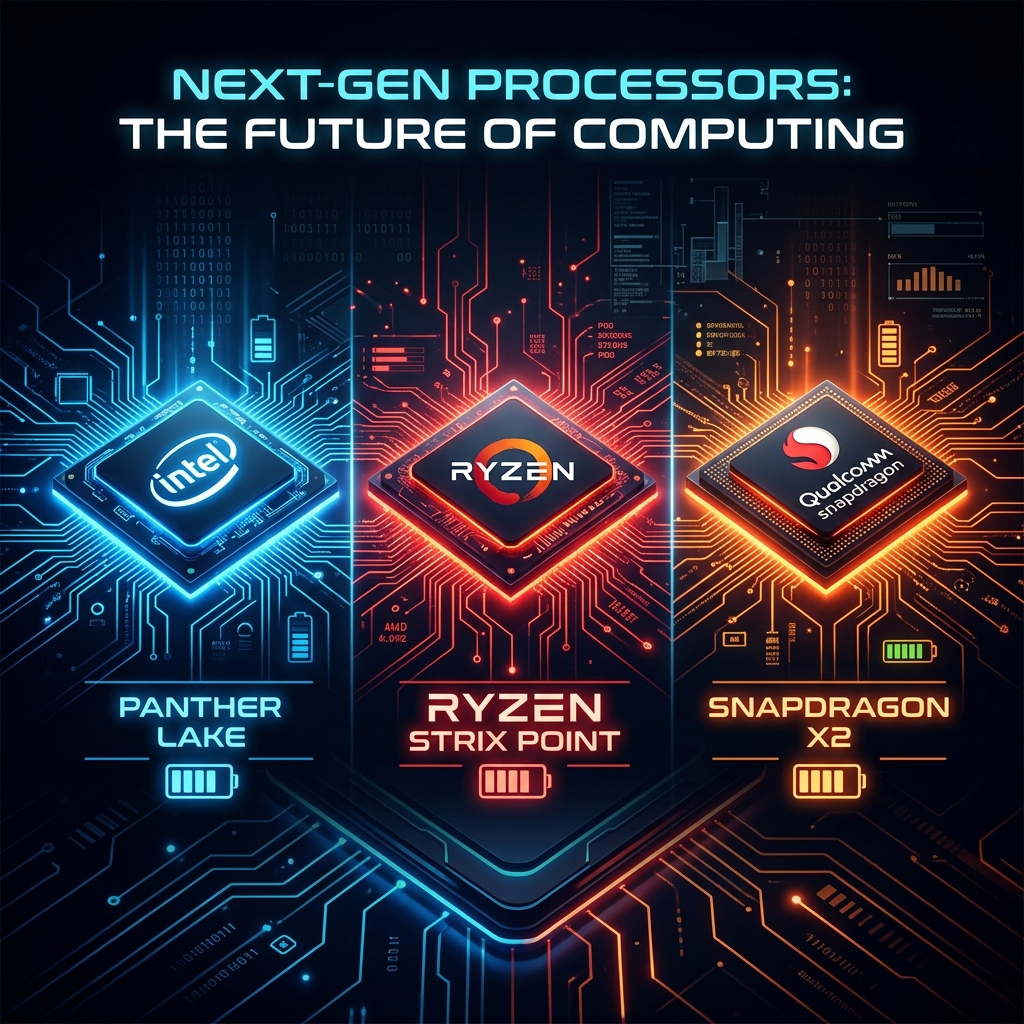
Just a month ago, the tech industry wrapped up its major summer keynotes. Following the full rollout of Apple’s M5 family over the past year and the ongoing barrage of Copilot+ PC announcements from the x86 camp since CES, one thing is abundantly clear: we are no longer talking about "AI TOPS" as a novelty. The NPU is just standard silicon plumbing now.
Instead, the conversation in mid-2026 has shifted back to the most ancient, stubborn metric in portable computing: active battery life.
With Intel's Panther Lake (Core Ultra Series 3) finally shipping in volume, AMD's Gorgon Point (Ryzen AI 400) occupying the premium Windows space, and Qualcomm’s sophomore Snapdragon X2 Elite notebooks hitting shelves, thin-and-light buyers have three radically different microarchitectures to choose from.
But if you cut through the marketing slides and look at the real review data, you’ll find that the old rules have been completely rewritten. The story of 2026 isn't just about ARM running away with the efficiency crown. It is about Intel closing the gap, and Qualcomm blinking on efficiency in pursuit of raw performance.
The Contenders: Architectural Philosophies
Before we look at the runtimes, we need to understand how we got here. Each chipmaker is using a completely different strategy to solve the performance-per-watt puzzle.
- Intel Panther Lake (Core Ultra Series 3): Following the radical shift of Lunar Lake, Panther Lake represents Intel’s refined tile-based architecture. Built on a mix of Intel 18A and TSMC advanced nodes, Intel has leaned heavily into "E-core first" scheduling. The low-power island handles your background tasks and light web browsing, keeping the hungry P-cores completely asleep unless you load a heavy compilation or rendering thread.
- AMD Gorgon Point (Ryzen AI 400): AMD's current platform is Gorgon Point, which is an iterative refresh of the previous year's Strix Point. Architecturally, it is near-identical, featuring the same hybrid layout of "Zen 5" and compact "Zen 5c" cores with only frequency, memory speed, and power-tuning adjustments. These Zen 5c cores are instruction-set identical to the performance cores but physically smaller and optimised for lower clock speeds, serving as a brute-force x86 efficiency engine.
- Qualcomm Snapdragon X2 Elite (Oryon Gen 3): Qualcomm’s sophomore silicon moves to the third-generation Oryon CPU cores (bypassing Gen 2 on PCs, which went to mobile). Operating natively on ARM64, the X2 Elite avoids the legacy baggage of the x86 instruction set entirely. Oryon Gen 3 concentrates power efficiency at the hardware level, relying on a custom microarchitecture built from the ground up rather than inherited from a legacy x86 lineage.
Test 1: Real-world browsing and streaming
There is no single lab that has put all three platforms through one identical battery loop, so the honest picture comes from reading across outlets and holding two variables in mind: the test type, and the battery size, which the marketing rarely mentions.
On the browsing side, Tom's Guide runs a continuous web-surfing loop over Wi-Fi at 150 nits. The Panther Lake Asus Zenbook Duo posted 14 hours 23 minutes there in single-screen mode, nearly six hours up on the Lunar Lake model it replaced, and comfortably ahead of AMD's Ryzen AI Max 385+ in the ROG Flow Z13 at 10 hours 16 minutes. Notebookcheck's own 150-nit Wi-Fi test had the Snapdragon X2 Elite in the Asus Zenbook A14 at around 16 hours, dropping to roughly 11 at full brightness.
Meanwhile, AMD's Gorgon Point position remains good but not class-leading. Notebookcheck rated the Asus Zenbook S16 running the Ryzen AI 9 465 (Gorgon Point, 83Wh battery, 35W sustained power limit) as having good battery life for its class, though reviewers have consistently noted that Arm-based machines still hold a noticeable lead in pure browsing endurance.
On streaming, PCWorld's Netflix rundown tells a more surprising story. The Snapdragon X2 Elite Extreme (X2E94100) managed 13 hours 4 minutes in their test, while the Panther Lake Zenbook Duo topped the chart at about 16.5 hours. That is the opposite of the old ARM-wins-runtime assumption, with one heavy caveat: the Intel laptop carried a massive 99Wh battery (the largest the FAA allows on planes), while the Qualcomm machine did not.
PCWorld's blunt conclusion is worth sitting with: Qualcomm appears to have tuned its second-generation Oryon design toward raw performance, and a first-generation Snapdragon X Elite is still the more power-efficient option if productivity runtime is your sole metric.
The takeaway is not that any one chip "wins" battery in 2026. It is that Panther Lake has closed the gap to the point where a big-battery Intel thin-and-light can out-last an ARM machine outright, and the second-generation Snapdragon traded some of its efficiency crown for speed.
Test 2: The x86 translation tax
This part of the ARM story has not changed, and the numbers are consistent across reviewers. On Windows on ARM, legacy x86 apps run through Microsoft's Prism translation layer, which is fast enough to feel native but is not free. Parsing x86 instructions into ARM on the fly burns extra CPU cycles, and that shows up at the battery.
Aggregated across reviewer and user testing (rather than a single controlled benchmark), the penalty lands at roughly 20 to 30% more battery drain when your daily apps run under emulation rather than as native ARM builds, with the hit climbing toward a third of CPU overhead for AVX-heavy workloads.
In 2026, most mainstream apps (Office, Chrome, Photoshop, Slack) ship native ARM64 versions, so many users rarely touch Prism. But if your workflow leans on a legacy database, a proprietary corporate tool, or a niche utility that never made the jump, a chunk of the ARM battery advantage evaporates.
Test 3: Standby and Idle States
Standby behaviour is another area where the lines are starting to blur. While we don't have perfectly comparable, cross-platform standby percentages from independent testing labs, the structural difference remains clear.
ARM-based machines still tend to behave more like smartphones at idle, waking up instantly and sipping negligible power when closed. However, Intel's "E-core first" scheduling on Panther Lake and AMD's power-tuning on Gorgon Point have narrowed this gap in daily standby behaviour. The days of opening your backpack to find an x86 laptop running hot and dead are largely behind us, even if Qualcomm still holds the structural edge in deep sleep states.
The Verdict: How to Choose in 2026
The "Battery War" of 2026 has no single victor, but it does have clear boundaries.
- Choose Qualcomm Snapdragon X2 if: You want peak single-threaded performance and phone-like standby behaviour, and you are running a fully modernised, ARM-native software suite. Just be aware that you are no longer buying the absolute battery champion of the laptop world. It has traded some of its endurance to fight x86 in performance.
- Choose Intel Panther Lake if: You want to maximise your runtime without thinking about software compatibility. With a large enough battery (like the 99Wh cells hitting premium laptops), Panther Lake can outrun Qualcomm’s newest chips while maintaining native x86 support. It represents the most complete x86 efficiency comeback in years.
- Choose AMD Gorgon Point if: You need sustained multi-threaded power for rendering or engineering workloads alongside native x86 compatibility. While it lands behind the ultra-low-power web browsing runtimes of Intel and Qualcomm, it scales efficiently under heavy, continuous processing loads. (Note: Devices shipping with the older Strix Point chips perform near-identically here, making them great discount alternatives.)
NPUs might have sold the laptop upgrades of 2026, but it's the quiet engineering under the hood that makes them worth keeping.
Are you planning to make the jump to ARM this year, or is Intel's x86 efficiency comeback enough to keep you on team blue? Let's discuss in the comments.
Sources & References
- Tom's Guide: We just benchmarked the Intel Core Ultra X9 388H — AMD is officially on notice (Panther Lake Zenbook Duo web-surfing runtime at 150 nits, plus Lunar Lake and Ryzen AI Max comparisons).
- Notebookcheck: The Asus Zenbook A14 powered by the Snapdragon X2 Elite is the perfect mobile companion (Snapdragon X2 Elite Wi-Fi runtime at 150 nits).
- Notebookcheck: The perfect everyday laptop with AMD Ryzen 400 — Asus Zenbook S16 OLED review (Gorgon Point Ryzen AI 9 465 battery, 83Wh, 35W sustained).
- PCWorld: Tested: Qualcomm's Snapdragon X2 Elite is faster, but the battery life hit is real (streaming rundown: X2 Elite Extreme vs 99Wh Panther Lake Zenbook Duo, and the first-gen X Elite efficiency verdict).
- PCWorld: Intel Core Ultra X9 388H review: epic graphics, battery life (Panther Lake efficiency and battery context, including the 99Wh Zenbook Duo caveat).
- Translation tax: the 20 to 30% figure is an aggregate of multiple reviewer and user reports on Microsoft's Prism emulation layer, not a single controlled benchmark.
More from the desk
Samsung Showcases Odyssey G8 6K Gaming Monitor at Gamescom 2026
Samsung headlines Gamescom 2026 with the Odyssey G8 (G80HS), showcasing the industry's first 6K gaming monitor alongside the PCIe 5.0 SSD 9100 PRO.
Galaxy Unpacked July 2026: Z Fold8 Ultra, Watch Ultra 2, and Intelligent Eyewear Unveiled
Samsung's July 2026 Unpacked event delivered a massive ecosystem expansion, introducing the Galaxy Z Fold8 Ultra, the Snapdragon-powered Watch Ultra 2, and Android XR intelligent eyewear.
Two Years of Copilot+: You Were Sold Intelligence, You Bought Efficiency
NPUs are now standard plumbing in modern laptops. But the real value of the neural engine is not the "AI magic" Microsoft marketed: it is silence, efficiency, and battery life.