
AMD Extends AM5 Socket Support Through 2029: What It Means for PC Builders
AMD's commitment to supporting the AM5 desktop socket through 2029 offers rare platform longevity in an era of surging PC component costs.
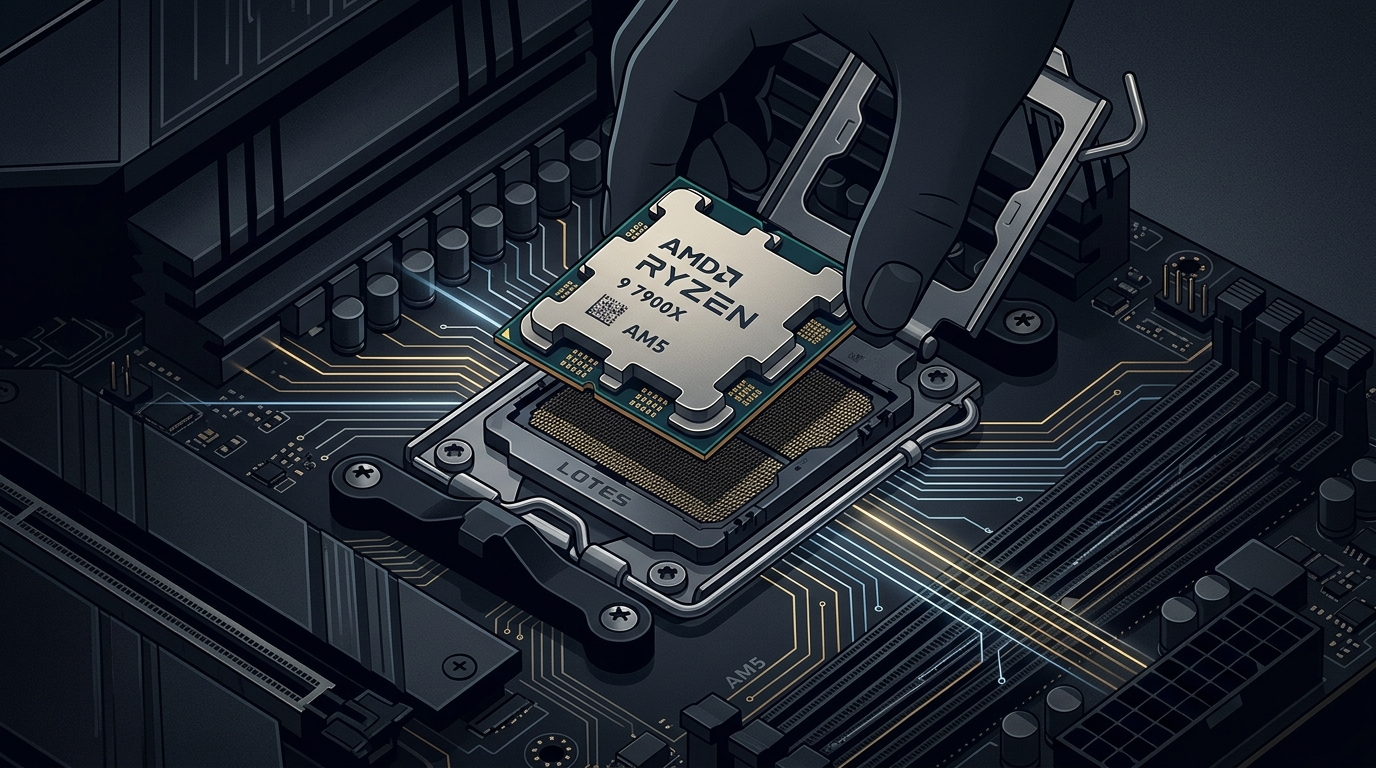
Building a desktop PC in 2026 requires more financial calculation than it did a few years ago. High-speed GDDR7 memory supply bottlenecks have kept premium graphics cards expensive, high-capacity PCIe 5.0 SSDs carry hefty price tags, and overall system building budgets are under constant pressure. In this environment, the hidden cost of system upgrades often comes down to motherboard turnover. Having to swap out a motherboard, re-route power supply cables, and reinstall storage every time you step up to a faster CPU is both an expensive and time-consuming chore.
That is precisely why AMD's official announcement extending AM5 socket support through at least 2029 is one of the most consequential platform developments for PC builders. By guaranteeing that the LGA1718 socket will remain the desktop standard for at least seven years following its late 2022 debut, AMD is offering a clear, multi-generation upgrade path that stands in stark contrast to traditional industry socket cycles.
Amortizing Motherboard Costs in an Expensive Era
Motherboards are no longer simple interconnect boards. High-end X670, B650, and X870 platforms pack heavy-duty voltage regulator modules (VRMs) for aggressive boost clocks, multi-layer PCB traces for PCIe 5.0 signal integrity, and integrated USB4 controllers. As a result, solid AM5 boards regularly cost between $200 and $400.
When a CPU socket is abandoned after just two processor generations, builders are forced to write off that motherboard investment far earlier than necessary. By extending AM5 support through 2029, a builder who bought an AM5 motherboard in 2022 or 2024 can drop in future CPU upgrades without buying a new board, re-mounting complex liquid coolers, or replacing system memory.
Over a seven-year span, skipping even one or two motherboard replacements frees up hundreds of dollars in a build budget. That money can be redirected toward higher-tier GPUs, larger storage volumes, or faster DDR5 RAM kits.
The Architecture Roadmap: Zen 5, Zen 6, and Beyond
When AM5 first launched with Ryzen 7000 processors, AMD originally committed to supporting the platform "through 2025 and beyond." That commitment was later pushed out to 2027, and now officially stands at 2029.
What does this extended timeline actually mean for future CPU compatibility?
- Current Generations: AM5 currently hosts Ryzen 7000 (Zen 4), Ryzen 8000-series desktop APUs with integrated RDNA 3 graphics, and Ryzen 9000 (Zen 5) desktop chips, including popular 3D V-Cache gaming CPUs like the Ryzen 7 7800X3D and recent mid-range additions like the Ryzen 7 7700X3D.
- Next-Gen Architectures: Extending support through 2029 ensures that upcoming microarchitectures, including Zen 6 and potentially early iterations of Zen 7, will share the exact same LGA1718 physical footprint and electrical pinout.
- BIOS Updates: Motherboard vendors will continue releasing AGESA firmware updates to ensure existing 600-series and 800-series chipsets can initialize future processors cleanly.
While earlier motherboard chipsets may lack niche features introduced on future flagship boards, the core compute capabilities, PCIe lanes, and memory channels will remain fully functional across generations.
Platform Strategy: AMD AM5 vs. Intel Sockets
The contrast between AMD and Intel when it comes to socket longevity remains one of the sharpest structural differences in the x86 desktop market.
Historically, Intel has adhered to a strict two-generation cadence per socket. For example, LGA1700 spanned 12th Gen Alder Lake and 13th/14th Gen Raptor Lake before giving way to LGA1851 for Arrow Lake processors. While this approach allows Intel to redesign power delivery pinouts and memory topologies frequently, it forces builders to buy a new motherboard every two product cycles.
AMD, by comparison, turned socket longevity into a core competitive advantage with AM4. Launched in 2016, AM4 supported four distinct CPU microarchitectures (Zen, Zen+, Zen 2, and Zen 3) over nearly a decade. AMD still supports AM4 today with specialized budget chips, demonstrating how long-lived platforms build customer loyalty. Extending AM5 to 2029 signals that AMD is doubling down on this exact blueprint.
What PC Builders Should Consider Today
If you are planning a new desktop build or evaluating an upgrade path, AMD's extended AM5 timeline provides several practical advantages:
- Invest in Quality Motherboard Power Delivery: Because your motherboard could plausibly host a high-core-count CPU released in 2028 or 2029, spending an extra $30 to $50 for robust VRM cooling and PCIe 5.0 support makes economic sense.
- Modular Drop-In Upgrades: A builder starting today with a modest 6-core or 8-core Ryzen processor can drop in a top-tier Zen 6 3D V-Cache chip four years from now without rebuilding the entire system from scratch.
- Resale and Second-Life Value: Motherboards with long-term CPU support retain higher secondhand value, as buyers looking to upgrade older systems actively search for compatible AM5 boards.
In an era where tech components are increasingly expensive and short-lived, AMD's commitment to AM5 through 2029 offers builders something rare: predictability and lasting value.
Sources & References
- AMD Official Blog: AMD at Computex 2026: 10 Years of AM4 and AM5 Support Through 2029 (Accessed July 2026)
- AMD Official: AMD Socket AM5 Motherboards & Chipset Overview (Accessed July 2026)
- TechPowerUp: AMD Announces Socket AM5 Longevity till 2029 (Accessed July 2026)
- TechPowerUp: AMD Formally Announces Ryzen 7 5800X3D 10th Anniversary Edition and Ryzen 7 7700X3D (Accessed July 2026)
- TechPowerUp: AMD Zen 5 Chiplet Built on 4 nm, "Granite Ridge" First Model Numbers Leaked (Accessed July 2026)
More from the desk
Part VIII: Building the PC
Finally the day has come to share my complete gaming build. It has been a long journey due to the delay in getting the latest parts. I started buying the parts from August and finally managed t...

Part VII: Deciding the storage (SSD/HDD)
Storage storage and more storage! No matter how much storage we have it is never going to be sufficient. This is especially true when we have a lot of games and videos stored in our PCs. The use of o...

Part VI: Deciding the power supply
When it comes to power supplies (PSU - power supply unit), it is one of the most overlooked PC components but is one of the important parts of a build. If you check on Amazon or any other site, you w...