
The Need for Speed: A Deep Dive into Wi-Fi Standards
You see it everywhere: on your phone, your laptop, and your smart fridge. Wi-Fi. It's the invisible force that connects our world, but beneath the simple "Wi-Fi" logo is a complex, constantly evolving...
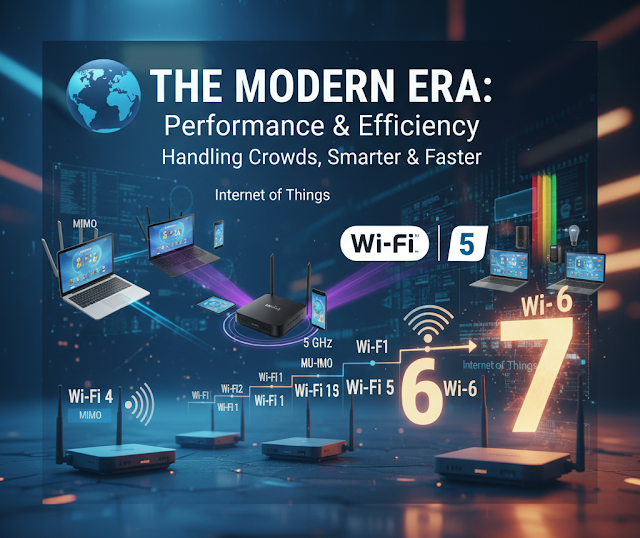
You see it everywhere: on your phone, your laptop, and your smart fridge. Wi-Fi. It's the invisible force that connects our world, but beneath the simple "Wi-Fi" logo is a complex, constantly evolving technology governed by the IEEE 802.11 standards.
From the slow, clunky days of 802.11b to the bleeding-edge performance of Wi-Fi 7, let's explore this incredible evolution and the key innovations that keep our data flowing faster than ever.
The Evolution of Speed: From Alpha to Ax
For years, consumers had to learn confusing technical names like 802.11g or 802.11n. To make things easier, the Wi-Fi Alliance introduced simplified, generational names (Wi-Fi 4, 5, 6, etc.), but the underlying technical standard remains the same: IEEE 802.11 followed by a letter suffix.
The Pioneers (Pre-Generation)
| Standard | Wi-Fi Name | Ratified | Frequency Band | Max Theoretical Speed | Key Innovation |
|---|---|---|---|---|---|
| 802.11b | Wi-Fi 1 | 1999 | 2.4 GHz | 11 Mbps | The first widely adopted standard. Made wireless connectivity popular. |
| 802.11a | Wi-Fi 2 | 1999 | 5 GHz | 54 Mbps | Introduced the less-cluttered 5 GHz band and OFDM modulation. |
| 802.11g | Wi-Fi 3 | 2003 | 2.4 GHz | 54 Mbps | Combined the speed of 802.11a with the range of 802.11b. |
The Modern Era: Performance & Efficiency
The true revolution in modern Wi-Fi started with the move beyond just increasing raw speed. Beginning with Wi-Fi 4, the focus shifted to efficiency , capacity , and handling a rapidly growing number of connected devices (our "Internet of Things").
4. Wi-Fi 4 (802.11n) - The MIMO Revolution
-
Ratified: 2009
-
Bands: 2.4 GHz & 5 GHz
-
Max Speed: Up to 600 Mbps
The game-changer here was MIMO (Multiple-Input, Multiple-Output) technology. MIMO uses multiple antennas on both the router and the client device to send and receive several data streams simultaneously, dramatically increasing both speed and range.
5. Wi-Fi 5 (802.11ac) - Focusing on 5 GHz
-
Ratified: 2013
-
Bands: 5 GHz Only (most commonly)
-
Max Speed: Up to 3.5 Gbps
Wi-Fi 5 pushed speed limits by focusing almost exclusively on the 5 GHz band. It introduced wider channel widths (up to 160 MHz) and Multi-User MIMO (MU-MIMO) , which allowed the router to send data to multiple devices at the same time (though initially only in the downlink direction), significantly improving network efficiency.
6. Wi-Fi 6 (802.11ax) - Efficiency in Crowds
-
Ratified: 2019
-
Bands: 2.4 GHz & 5 GHz
-
Max Speed: Up to 9.6 Gbps
Wi-Fi 6 is about dealing with congestion. While the theoretical top speed is faster, its main benefit is improving performance in crowded environments (like a busy office or a smart home with 50 devices). Key features include:
-
OFDMA (Orthogonal Frequency-Division Multiple Access): This allows a single transmission channel to be sliced into smaller resource units (RUs), enabling the router to send data to multiple different devices simultaneously within the same channel. Think of it as a shared taxi instead of a private car for every single data packet.
-
Target Wake Time (TWT): This is a power-saving feature that lets the router and device schedule when the device should wake up to receive data, saving battery life on phones and IoT devices.
The New Frontier: Wi-Fi 6E, 7, and Beyond
The current focus is on opening up new, clear airspace and leveraging revolutionary techniques for latency and throughput.
Wi-Fi 6E (Extension of Wi-Fi 6)
- Bands: 2.4 GHz, 5 GHz, 6 GHz
Wi-Fi 6E is not a new standard but an extension of 802.11ax. The "E" stands for Extended , meaning it adds support for the newly available 6 GHz frequency band.
This band is like a vast, empty highway: it's free from the congestion of the 2.4 GHz and 5 GHz bands and allows for ultra-wide 160 MHz channels with very low interference, providing massive capacity and incredibly low latency.
Wi-Fi 7 (802.11be) - Extremely High Throughput (EHT)
-
Expected Ratification: 2024
-
Bands: 2.4 GHz, 5 GHz, 6 GHz
-
Max Speed: Up to 46 Gbps (Theoretical)
Wi-Fi 7, or Extremely High Throughput (EHT) , is built for the future of AR/VR, 8K streaming, and multi-gigabit internet connections. It builds on the success of 6E with a few truly transformative features:
-
320 MHz Channels: Wi-Fi 7 doubles the maximum channel bandwidth (up to 320 MHz) in the 6 GHz band, effectively doubling the data pipeline.
-
4096-QAM (Quadrature Amplitude Modulation): This advanced encoding scheme packs 20% more data into the same transmission signal compared to Wi-Fi 6's 1024-QAM.
-
Multi-Link Operation (MLO): This is the biggest leap. MLO allows a single device to send and receive data simultaneously across different frequency bands (e.g., using 5 GHz and 6 GHz at the same time). This boosts speed, provides redundancy (less packet loss), and drastically lowers latency.
💡 Which Standard Should You Choose?
| Goal | Recommended Standard | Why? |
|---|---|---|
| Best Value / Future-Proofing | Wi-Fi 6 (802.11ax) | Excellent efficiency with OFDMA and TWT; great for dense device environments. |
| Maximum Speed / Low Latency | Wi-Fi 6E or Wi-Fi 7 | Utilizes the clear 6 GHz band. Ideal for gaming, AR/VR, and multi-gigabit fiber internet. |
| Basic Home Internet / Older Devices | Wi-Fi 5 (802.11ac) | Perfectly adequate for standard web browsing and 4K streaming. |
The key takeaway?
When buying a new router or device, look for the highest Wi-Fi number your budget allows. The increase in speed and, more importantly, efficiency in each new generation ensures your network can handle the ever-increasing demand for bandwidth in your connected life.
More from the desk
GTA VI Consoles Target 30 FPS at Launch as 60 FPS Hopes Fade
Following the 26-minute Extended Look reveal and developer comments, technical analyses indicate Grand Theft Auto VI is targeting 30 FPS on PS5 and Xbox Series X|S.
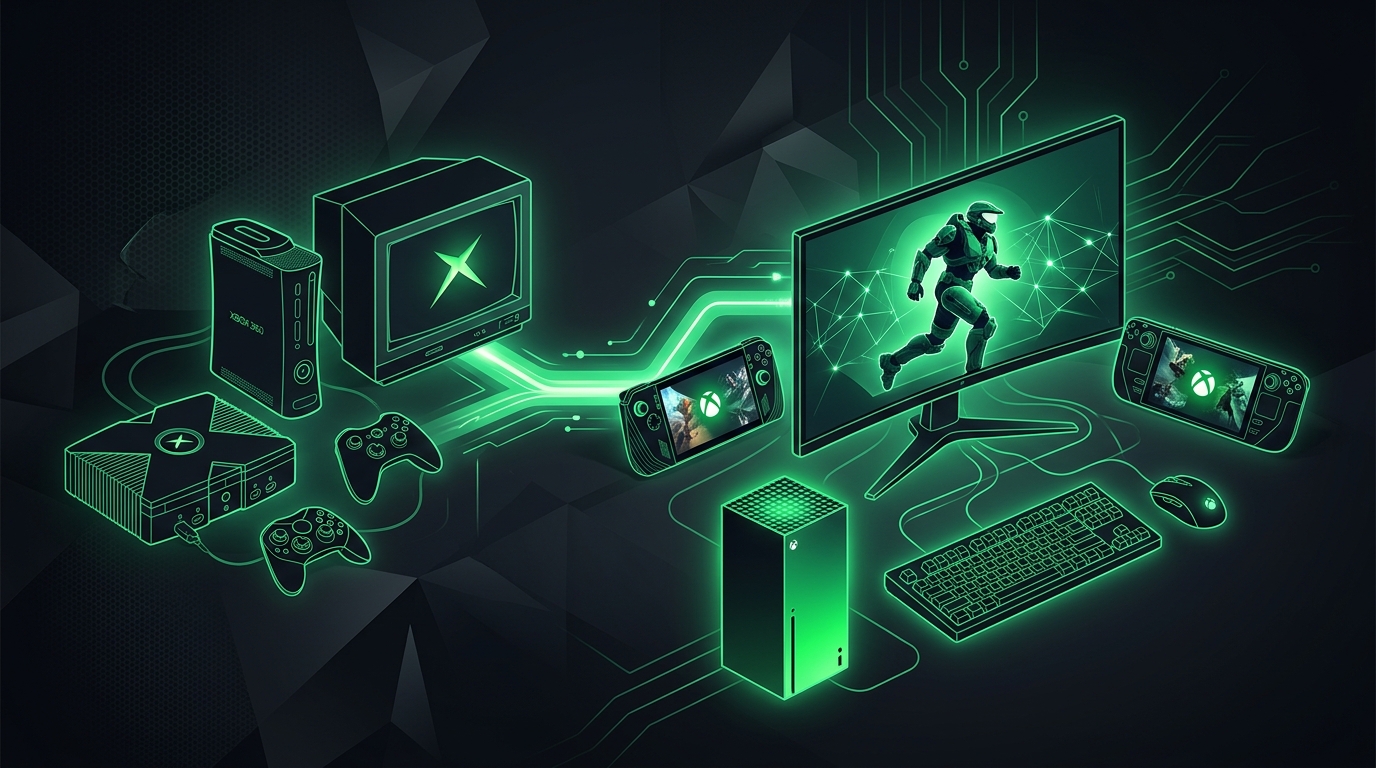
Microsoft Moves to Bring Legacy Xbox 360 Library to PC and Handheld Devices
Microsoft is expanding its game preservation strategy by preparing Xbox 360 titles for PC and handhelds, building on its recent original Xbox PC backward compatibility rollout.
Samsung Showcases Odyssey G8 6K Gaming Monitor at Gamescom 2026
Samsung headlines Gamescom 2026 with the Odyssey G8 (G80HS), showcasing the industry's first 6K gaming monitor alongside the PCIe 5.0 SSD 9100 PRO.